UN Climate Change Conference · COP31

Antalya, at the centre of climate diplomacy.

Türkiye hosts the 31st Conference of the Parties on 9–20 November 2026. This page brings together the programme, the negotiating agenda and Türkiye's climate profile, using the national data on this platform.

Time to opening
23Days
01Hours
43Minutes
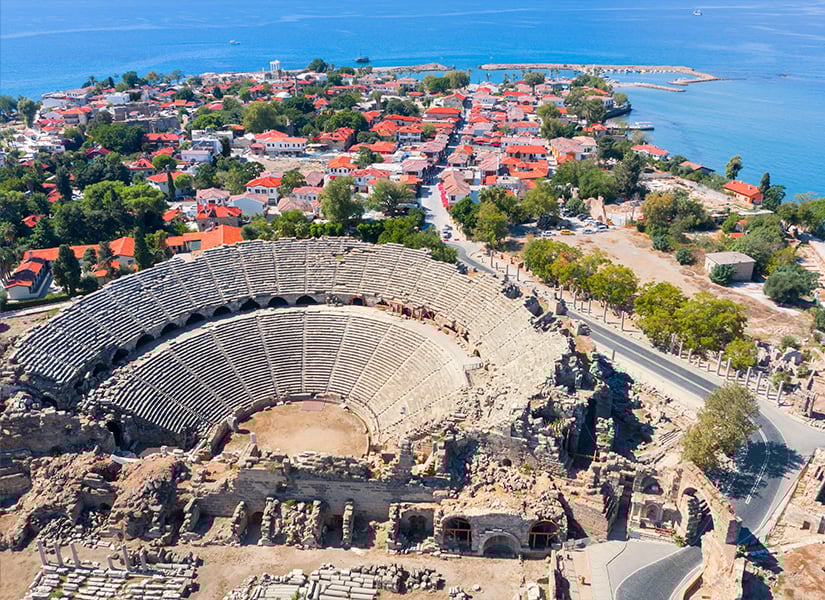
Ancient Theatre of Side · Antalya
Host cityAntalya9–20.11.2026
Ancient Theatre of Side · Antalya
9–20November 2026 · Antalya
197Parties
~100,000Expected participants
12Thematic days
COP31 President-DesignateTürkiye · host and Action Agenda
Murat Kurum
President of NegotiationsAustralia · negotiating process
Chris Bowen
Programme

Twelve days, twelve priorities

The COP31 Presidency has given each day a theme. Links on each card lead to the platforms where you can explore Türkiye's data on that theme.

  1. 01Mon 9 Nov
    Food, Agriculture and Health
  2. 02Tue 10 Nov
    Energy and Transport
  3. 03Wed 11 Nov
    Zero WasteLeaders Summit · Day 1
  4. 04Thu 12 Nov
    Resilient Cities and Built EnvironmentLeaders Summit · Day 2
  5. 05Fri 13 Nov
    Finance and Trade
  6. 06Sat 14 Nov
    Children, Youth, Education and Skills
  7. 07Sun 15 Nov
    A Breath in AntalyaSocial and cultural programme
  8. 08Mon 16 Nov
    Science, Industry and Technology
  9. 09Tue 17 Nov
    Ocean, Seas, Nature and Land UseRio Synergy
  10. 10Wed 18 Nov
    Human and Social Development
  11. 11Thu 19 Nov
    İmece: Enhancing Implementation
  12. 12Fri 20 Nov
    Final Negotiations
Türkiye's climate profile

What data does Türkiye bring to the table?

Türkiye's emissions curve from the national greenhouse gas inventory, and the 2035 cap set in its second NDC.

584.5MtTotal emissions in 2024 (excl. LULUCF)National inventory · TurkStat
+155%Change since 1990National inventory · TurkStat
16thWorld rank by total emissions (EDGAR 2024)EDGAR 2025 · JRC
6.8Emissions per capita, t CO₂e (EDGAR 2024)EDGAR 2025 · JRC

Greenhouse gas emissions by sector, Mt CO₂e

1990–2024 national inventory; areas are sectors excluding LULUCF, the dark line is net emissions including LULUCF; the grey area is the period to 2035.

  • Waste
  • Agriculture
  • Industrial processes
  • Energy
  • Net emissions (incl. LULUCF)
  • 2035 NDC cap (net)
0200400600800199020002010202020352035 NDC cap (net) · 643 Mttarget period
Show data as a table
YearEnergyIndustrial processesAgricultureWasteGrossLULUCFNet
2024419.975.773.515.4584.5-67.1517.4
2023397.870.771.814.9555.2-69.2486
2022401.972.371.515.6561.3-56.3505
2021408.376.575.415.1575.3-48527.3
202037268.976.416.6534-57.7476.3
2019370.460.371.516.6518.7-64.4454.3
2018378.668.668.917.3533.5-70.5463
2017384.667.266.317535.2-76.1459.1
2016365.164.161.717.4508.3-73.8434.5
2015346.560.459.217.9483.9-73410.9
2014329.860.859.517.3467.3-77390.3
2013311.66059.417.4448.5-76.5372
2012324.756.956.318.4456.3-73.5382.8
2011312.354.750.318.6435.8-75.7360.1
2010290.849.747.718.2406.4-72.1334.3
2009295.843.845.118402.6-70.8331.8
2008290.942.344.817.9395.9-67.9328
200729540.247.217.8400.1-72328.1
200626437.247.617.5366.2-71.6294.6
2005247.834.746.317345.8-72.2273.6
200423031.24516.6322.7-69.9252.8
2003224.328.644.216.1313.2-71.3241.9
2002209.927.340.715.6293.5-69.3224.2
2001203.526.343.715.1288.7-70.7218
2000220.226.64614.6307.5-68.2239.3
1999198.226.248.214.1286.7-71.2215.5
1998200.227.847.713.6289.2-70.6218.6
1997200.327.446.813.1287.7-70.5217.2
1996188.226.649.512.5276.9-67.3209.6
1995170.325.94912.1257.4-67.9189.5
1994157.124.550.311.7243.6-68175.6
1993160.825.152.811.3250-66.7183.3
1992154.424.652.711242.7-67.4175.3
199114824.952.910.7236.4-67.4169
1990143.723.151.810.3228.9-66.4162.5

The 643 Mt cap in the second NDC applies to net emissions including LULUCF and corresponds to a 466 Mt cut against the reference scenario, so the dark line is the series to compare with the target. Net emissions in 2024 were 517.4 Mt, 125.6 Mt below the cap.

Emissions per capita, t CO₂e

The two host countries and major emitters; dashed line is the world average.

  • Australia22.3
  • United States17.3
  • China10.8
  • EU-277.1
  • Türkiye6.8
  • World6.6
  • India3

EDGAR 2025 (JRC), 2024 · GWP-100 AR5

Negotiating agenda

What is on the table in Antalya?

Six headline issues: what each one is, why it matters, and what it means for Türkiye.

NDC 3.0

New national contributions

What is it?
Parties have submitted their third round of NDCs, setting targets for 2035.
Why it matters
The gap between combined pledges and a 1.5 °C pathway is the yardstick COP31 will be judged by.
For Türkiye
Second NDC: a 466 Mt cut against the reference scenario in 2035, capping emissions at 643 Mt CO₂e; net zero by 2053.
NCQG

Climate finance

What is it?
The new collective goal agreed at COP29: at least USD 300 billion a year by 2035.
Why it matters
Developing countries' ability to deliver their NDCs depends heavily on access to finance.
For Türkiye
Türkiye is listed in Annex I but not Annex II, so it carries no obligation to provide finance.
Article 6

Carbon markets

What is it?
Article 6 of the Paris Agreement: transfers of emission reductions between countries and a UN-supervised crediting mechanism.
Why it matters
How the rules are operationalised decides credit integrity and whether double counting is avoided.
For Türkiye
The Turkish Emissions Trading System (TR ETS), established by the Climate Law, has entered its pilot phase.
GGA

Adaptation

What is it?
Tracking the Global Goal on Adaptation with measurable indicators and scaling up adaptation finance.
Why it matters
Heatwaves, drought and floods are intensifying regardless of how the mitigation debate goes.
For Türkiye
The Mediterranean basin is a climate-change hotspot; Türkiye is implementing its 2024–2030 Adaptation Strategy and Action Plan.
L&D

Loss and damage

What is it?
The size and disbursement model of the fund operationalised at COP28.
Why it matters
The most vulnerable countries are pressing harder for support beyond the limits of adaptation.
For Türkiye
As host, Türkiye is emphasising a bridging role between developed and developing countries.
ETF

Transparency

What is it?
The Enhanced Transparency Framework: Parties report Biennial Transparency Reports (BTRs) and inventories under common rules.
Why it matters
Verifiable pledges are the foundation of COP31's claim to be an "implementation COP".
For Türkiye
Türkiye submitted its first BTR in 2024; its 1990–2024 national inventory is the source of this platform's sector data.
Presidency agenda

Priorities set by Türkiye

The COP31 Presidency's Action Agenda is built around ten themes; three initiatives are already announced.

  • Zero Waste
  • Oceans and Seas
  • Food Security
  • Climate-Resilient Cities
  • Climate Implementation Bridge (CIB)
  • Youth and Education
  • Green Industrialization
  • Clean Energy Transition
  • Rio Synergy
  • Dynamic and Resilient Health Systems

35-by-35 Global Electrification Pledge

Aims to raise electricity's share of global final energy consumption to 35% by 2035.

Climate Implementation Bridge (BRIDGE)

Pilot countries: Ethiopia, Fiji, Indonesia, Pakistan and Uzbekistan.

Antalya Pledge on AI

Announced at New York Climate Week, an initiative on using AI for clean technologies.

The host city's climate

A conference where climate risk is most visible

The Mediterranean basin is warming faster than the global average. Model projections for Antalya and extreme weather events recorded in Türkiye.

21.5°CMean annual temperature in 2050, Antalya · +2.9 °C1991–2020 average 18.6 °C
156Days above 30 °C per year by 2050CMIP6 HighResMIP · near-RCP8.5 pathway
−12.7%Change in annual rainfall by 2050CMIP6 HighResMIP · near-RCP8.5 pathway
450Forest fires in Antalya, 2024estimated burnt area 6,800 ha · General Directorate of Forestry

Days above 30 °C in Antalya, projection

Model mean; baseline 1991–2020.

801001201401601801991–2020 avg · 95202520302035204020452050156

Extreme weather events in Türkiye, annual count

Turkish State Meteorological Service records; latest year highlighted.

05001,0001,5002,000197019801990200020102020
From Rio to Antalya

Thirty-four years in brief

  1. 1992

    Rio · UNFCCC

    The UN Framework Convention on Climate Change opened for signature.

  2. 1997

    COP3 · Kyoto

    The protocol setting binding cuts for developed countries.

  3. 2004

    Türkiye joins the Convention

    Türkiye became a Party to the UNFCCC and joined the Kyoto Protocol in 2009.

  4. 2015

    COP21 · Paris

    Goal to hold warming well below 2 °C, pursuing 1.5 °C.

  5. 2021

    Paris ratified, 2053 goal

    Türkiye ratified the Paris Agreement and announced its 2053 net-zero goal.

  6. 2023

    COP28 · Dubai

    First Global Stocktake; a call to transition away from fossil fuels.

  7. 2024

    COP29 · Baku

    The New Collective Quantified Goal on finance was adopted.

  8. 2025

    Climate Law · COP30 Belém

    Climate Law No. 7552 entered into force; the second NDC was submitted; Türkiye was confirmed as COP31 host.

  9. 2026

    COP31 · Antalya

    "From dialogue to consensus, from consensus to action."

Global milestone Türkiye
COP glossary

To follow the negotiations

COP
Conference of the Parties; the UNFCCC's annual decision-making body.
CMA
The COP serving as the meeting of the Parties to the Paris Agreement.
NDC
Nationally Determined Contribution; each country's climate target, updated every five years.
BTR
Biennial Transparency Report on emissions and progress.
NCQG
New Collective Quantified Goal on climate finance.
GST
Global Stocktake; the five-yearly assessment of collective progress.
Annex I / II
Country lists in the Convention; Annex II carries finance obligations.
LULUCF
Land Use, Land-Use Change and Forestry (LULUCF).

More on Climatepedia →

Documents

Reading list

Full document archive →

The implementation COP

From pledges to measurable action

COP31's core message is implementation. Calculate your organisation's emissions with IPCC methods and compare your net-zero pathway with national targets.

Sources

This is an independent information page prepared by GHG Türkiye; it has no official link to the COP31 Presidency or the UNFCCC. Programme details come from official announcements and may change.