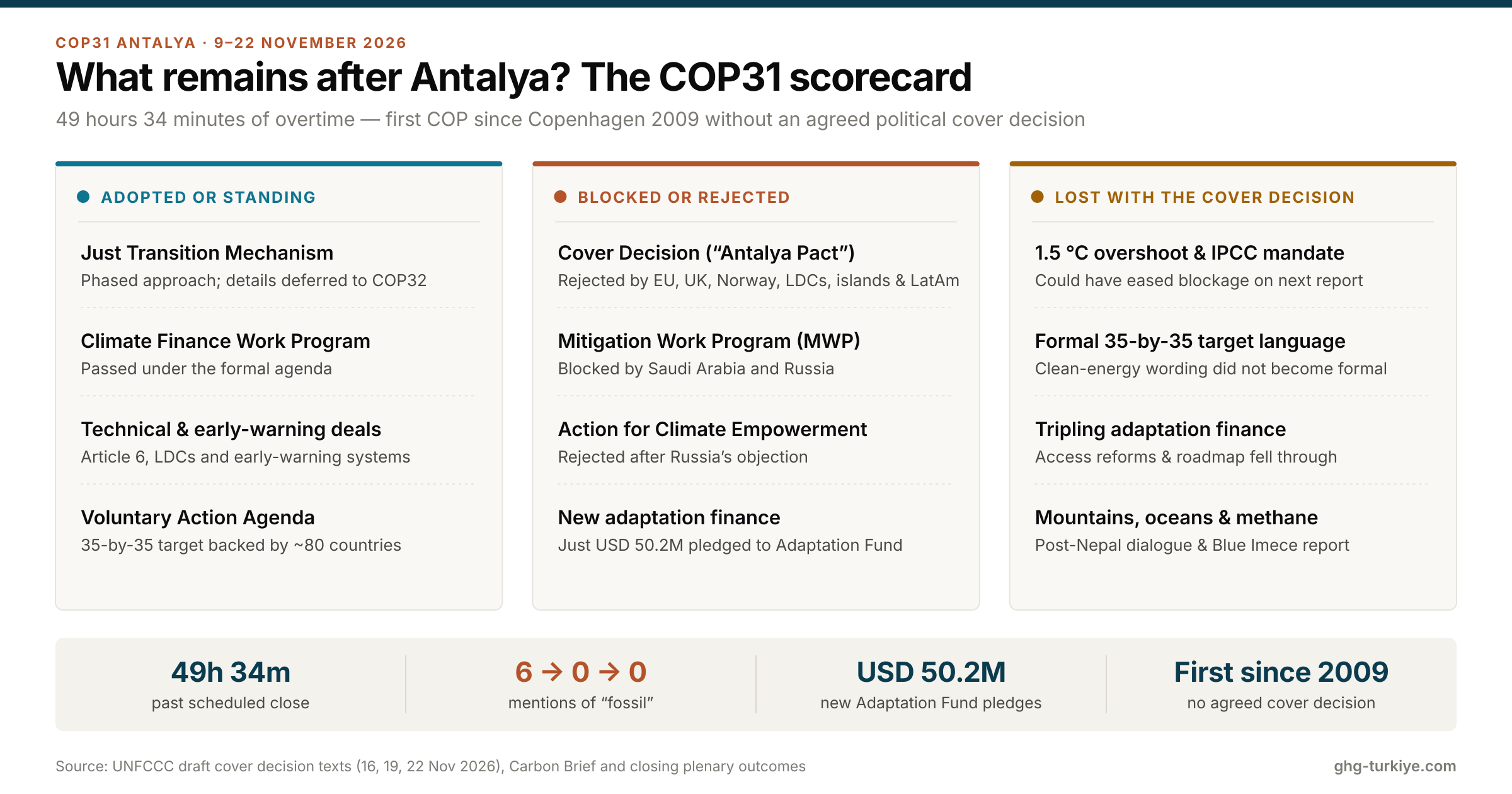
Scheduled to conclude at 18:00 on 20 November 2026, the 31st UN Climate Change Conference (COP31) in Antalya ran 49 hours and 34 minutes into overtime — surpassing the 44-hour record set at COP25 in Madrid — before closing at 19:34 on Sunday, 22 November, without an agreed high-level political cover decision. It was the first time since the 2009 Copenhagen Summit that a COP concluded without consensus on an overarching political text, though several formal agenda-item decisions were adopted and the Paris Agreement remains fully in force. This assessment examines the conference’s concrete results, the shift in fossil fuel references across the cover drafts, the implications of the rejected text, and the diplomatic agenda ahead for Türkiye.
Executive summary
Separating routine procedural matters — alongside technical decisions on Article 6, early-warning climate systems and least developed countries adopted in earlier sessions — COP31 yielded two notable formal negotiating outcomes: agreement to continue work on a phased approach toward a Just Transition Mechanism (with mandate and operational arrangements deferred to the 2027 Bonn sessions and COP32) and the Climate Finance Work Program. The remaining core political items failed to reach agreement.
At the closing plenary, the proposed cover decision (referred to as the “Antalya Pact”) was not adopted following formal objections from the European Union, the United Kingdom, Norway, the Least Developed Countries, small island developing states and several Latin American countries, primarily over the omission of explicit references to transitioning away from fossil fuels. According to closing plenary records and negotiation tracking by Carbon Brief, two formal agenda items were also blocked: Saudi Arabia and Russia prevented adoption and extension of the Mitigation Work Program (MWP), and Russia objected to the Action for Climate Empowerment (ACE) action plan. Outside the formal negotiating track, momentum centred on the voluntary Action Agenda — notably the non-binding “35-by-35” target to raise electricity’s share of global final energy consumption to 35% by 2035, backed by approximately 80 countries.
1. The breaking point: removal of fossil fuel references
The impasse over the cover decision can be traced through the trajectory of a single root term across six days. The word count is based on direct occurrences containing the root “fossil” in the English texts of the three primary UNFCCC draft cover decisions published on 16 November, 19 November and 22 November at 02:00. In the first draft (16 November, 144 paragraphs), “fossil” appeared six times: the text reaffirmed paragraph 28 of the first Global Stocktake — the COP28 call in Dubai to transition away from fossil fuels in energy systems — urged accelerated action toward phase-out, stressed ending inefficient fossil fuel subsidies and welcomed the COP30 Presidency’s roadmap for transitioning away from fossil fuels (detailed on the COP31 page).
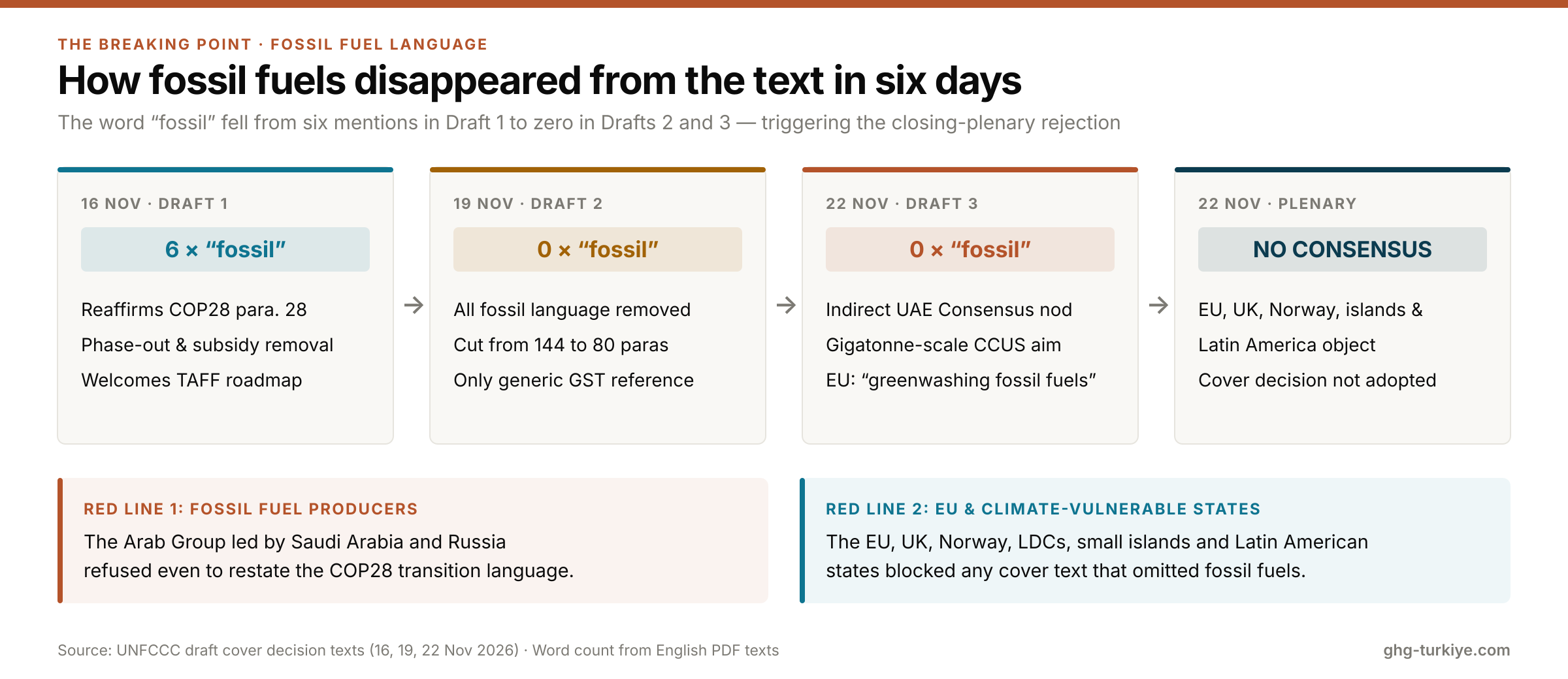
Three days later, the second draft (19 November, 80 paragraphs) narrowed the scope by nearly half and deleted every direct reference to fossil fuels: occurrences of “fossil” fell from six to zero, leaving only a general reference to implementing national plans informed by the first Global Stocktake. In the third draft (22 November 02:00, 94 paragraphs), the paragraph count rose again as several items — including gender, Indigenous Peoples’ rights, just transition and a reference to the UAE Consensus — were reinserted, yet the word “fossil” remained absent. While the preamble recalled “the United Arab Emirates Consensus in its entirety” without repeating its transition pledge, the operational text added a collective aspiration for gigatonne-scale carbon capture, utilisation and storage (CCUS) by 2035. A fourth and final version circulated hours later on 22 November with minor edits to CCUS and IPCC wording, but it likewise failed to win consensus. The European Union described pairing silence on fossil fuels with a CCUS target as “greenwashing fossil fuels”, whereas fossil fuel-producing countries led by Saudi Arabia within the Arab Group, together with Russia, objected even to restating the COP28 language. With neither red line yielding, COP31 President Murat Kurum recorded the lack of consensus and closed the session without adopting the decision.
2. Geopolitical and financial constraints
The breakdown in Antalya reflected structural geopolitical pressures on the UNFCCC process rather than textual disagreements alone. Global warming has moved past 1.5 °C, the remaining carbon budget is rapidly narrowing, and severe events such as the glacier collapse in Nepal underscored the immediacy of climate risks. At the same time, the United States had completed its withdrawal from the Paris Agreement. On 19 November — during COP31’s decisive second week — the leaders of the United States, Russia and China issued a trilateral statement calling for increased production and supply of refined petroleum products, further complicating the geopolitical backdrop in Antalya by signalling that China would not step into the leadership vacuum and that Russia was prepared to block.
Climate finance constituted the second major fault line. Developing countries entered the conference confronting a substantial gap between adaptation needs and available funding, yet new pledges from developed nations remained limited: contributions announced for the Adaptation Fund totalled USD 50.2 million, well below the scale sought by vulnerable states. This shortfall weakened the negotiating leverage of developed countries and left the objective of tripling adaptation finance caught in the broader deadlock among major powers. For its part, the joint Turkish–Australian presidency conducted an unusually transparent and inclusive consultation process during the first week. As positions hardened in the second week, the co-presidency continued seeking common ground through shuttle diplomacy; under such deeply entrenched red lines, however, unanimous agreement proved unattainable. This experience demonstrates the importance for future presidencies of preparing contingency options earlier when consensus stalls.
3. Negotiating gains lost with the cover decision
While rejecting a text that omitted direct fossil fuel references and elevated CCUS can be viewed as defending the scientific integrity of the process, the collapse of the cover decision also meant forfeiting several concrete provisions maintained across the three draft stages:
- 1.5 °C overshoot and the IPCC: the text acknowledged that warming is expected to exceed 1.5 °C and reaffirmed the guiding role of the IPCC — language that could have helped ease the months-long impasse involving Saudi Arabia, Russia and India over the next IPCC assessment cycle.
- Formal 35-by-35 electrification language: the global goal of raising electricity’s share of final energy consumption to 35% by 2035 had been brought from the voluntary Action Agenda into the draft decision, reinforced in the third draft by explicit clean-energy wording.
- Adaptation finance and access: even without a binding USD 120 billion floor, the text retained the commitment to triple adaptation finance by 2035 alongside measures to streamline access for developing countries.
- Mountains, oceans, methane and rights: a two-year work programme on mountains (particularly salient following the Nepal disaster), ocean outputs titled Antalya Ocean Current and Blue Imece, methane reduction provisions, the Belém Gender Action Plan and recognition of Indigenous Peoples’ rights under the UN Declaration all lapsed with the text.
4. Limits of unanimity: scientific and policy perspectives
The outcome in Antalya intensified debate over the governance architecture of UN climate negotiations. As noted in Le Monde, requiring unanimity among nearly 200 states exposes the limits of “consensus at all costs”: a small group of major fossil fuel producers can block foundational scientific language, confronting other delegations with a binary choice between endorsing a diluted document or concluding without an agreement. Academic commentary published by University College London (UCL) further observed that even a stalled summit provides a short-term advantage to oil- and gas-producing nations, since preventing a unified UN transition mandate leaves existing extraction trajectories unchallenged.
At the same time, assessments across the climate science community — including reactions compiled by the Science Media Centre and UCL researchers — largely regarded rejecting the weak text as the more defensible course. Climate specialists argued that declining an inadequate cover decision is preferable to adopting another agreement that fails to state clearly the need to transition away from fossil fuels, while cautioning that non-agreement must not become routine and that ambitious countries must substantiate their stance by halting new oil and gas development. Researchers tracking the global carbon budget highlighted the stark disconnect after 31 conferences, noting that governments still cannot agree on the core question of fossil fuels despite overwhelming scientific clarity; meteorological specialists similarly stressed that although political agreement is hard to reach, the scientific consensus is unambiguous and every year of delay compounds physical climate risks. Some researchers also suggested that drawing a firm line on fossil fuels could serve as a necessary reset, signalling that future UN agreements can no longer sidestep the primary driver of global warming.
From a policy perspective, analysts emphasize continuity alongside structural adaptation. The Atlantic Council underlined that the absence of a COP31 cover decision does not invalidate the Paris Agreement or prior COP commitments, which remain legally binding. At the same time, as geopolitical fragmentation strains universal consensus among 196 Parties, practical implementation is increasingly shifting toward plurilateral coalitions, targeted infrastructure partnerships and private-sector investment capable of advancing electrification and clean energy without awaiting unanimous diplomatic approval.
5. Implications for Türkiye and the road to COP32
Regulatory continuity. Despite the absence of a cover decision, technical decisions adopted under individual agenda items and existing Paris Agreement obligations remain fully in effect. While the formal deadline for Parties’ second Biennial Transparency Reports (BTR2) is 31 December 2026, Türkiye already fulfilled this obligation early by submitting its second report to the UNFCCC on 23 October 2026. Türkiye’s second NDC target — capping total greenhouse gas emissions at 643 Mt CO₂e by 2035 (accounting for LULUCF) — is unaffected, and the European Union’s Carbon Border Adjustment Mechanism (CBAM) timetable operates independently of COP cover texts.
The year ahead. Türkiye’s logistical execution and the Antalya venue received broad recognition across delegations, and the presidency’s mandate extends well beyond the closing session. As COP31 President, Türkiye holds a full year to collaborate with Ethiopia ahead of COP32 in Addis Ababa in 2027 — both to sustain momentum behind Antalya’s voluntary Action Agenda (including the non-binding 35-by-35 target backed by roughly 80 countries) and to help rebuild diplomatic trust prior to the next negotiating cycle. The full topic-by-topic archive of the three primary drafts is available on the COP31 page, and the underlying global emissions data are analysed in Who Emits the World’s Greenhouse Gases?.
References
- UNFCCC. Draft cover decision texts: 16/11/2026 12:40 (PDF), 19/11/2026 14:10 (PDF) and CMA version 22/11/2026 2:00 (PDF); Türkiye’s Second Biennial Transparency Report (BTR2), submitted 23 October 2026.
- Carbon Brief. COP31 Antalya: Key outcomes and negotiation chronology, November 2026.
- Ümit Şahin (Istanbul Policy Center, Sabancı University). The COP31 Outcome That Wasn’t, 23 November 2026.
- BBC News. COP31 climate talks collapse without a deal in Antalya, November 2026. Link
- 350.org. COP31: A summit for polluters, not for the people, November 2026. Link
- Climate Action Network International. COP31: A Shameful Failure, 22 November 2026. Link
- Le Monde. COP31: The limits of consensus at all costs, 23 November 2026. Link
- Atlantic Council. Why COP31 climate talks collapsed and what to expect next, November 2026. Link
- Science Media Centre. Expert reaction to COP31 failing to reach agreement, November 2026. Link
- University College London (UCL). Comment: COP31 — why the UN climate summit ended in victory for fossil fuel producing nations, November 2026. Link
- Down To Earth. COP31 coverage of the draft cover decisions, 17–22 November 2026. Link